
The history of Islam in Spanish America cannot be reduced to absence. Even where Arabic manuscripts are rare and explicit Muslim identity was legally suppressed, Islamicate influence remained visible in architecture, contested in law, and present through Moriscos, enslaved Africans, and figures such as Estevanico.
Introduction
The study of Islam in Spanish America is often approached through a problem of evidence. There are few surviving Arabic documents from the early colonial Spanish-American archive, and Spanish law formally restricted the migration of Muslims, Jews, and recent converts whose ancestry challenged claims of limpieza de sangre, or Old Christian purity. Yet the absence of abundant Arabic texts should not be mistaken for the absence of Islamicate influence.1
This article argues that Islam and the memory of Islam entered Spanish America through several overlapping channels: Mudéjar architecture and craft traditions transmitted from Iberia; the documented but constrained presence of Moriscos; the arrival of enslaved West Africans from Islamized regions; and the career of Estevanico, the Moroccan-born captive from Azemmour who became one of the most consequential guides in early Spanish exploration of North America.
Iberia as an Islamicate Bridge
Spanish America did not inherit a culturally uniform Catholic Spain. It inherited a post-Andalus Iberian world shaped by centuries of Muslim rule, Christian reconquest, forced conversion, and continuing artistic transmission. The term Mudéjar describes the survival and adaptation of Islamic artistic and technical forms under Christian rule. In the Americas, these forms appeared not as formal Islamic religious architecture, but as inherited systems of carpentry, ornament, spatial planning, and decorative geometry.
Mudéjar traditions included artesonado wooden ceilings, rhythmic arcades, geometric surface design, tilework, and courtyard-centered plans. In New Spain and other Spanish-American regions, these techniques moved through builders, craftsmen, friars, and institutions. Their presence in convents and churches does not prove that the buildings were Muslim spaces. Rather, it shows that Spanish colonial Christianity itself carried Islamicate material inheritances across the Atlantic.2
Interpretive point: Mudéjar architecture should not be framed as proof of hidden mosques in colonial Mexico. Its importance is more precise: it documents the transmission of Islamicate forms into Spanish America through Iberian culture.
Material Continuity in the Built Environment
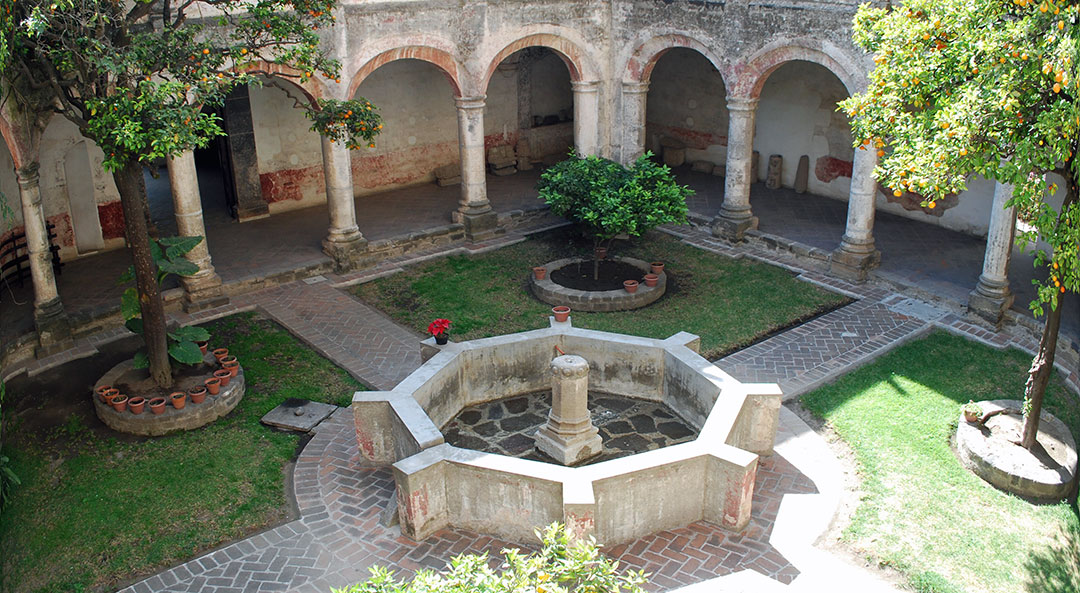
The Convent of San Miguel Arcángel at Huejotzingo is useful as a hero image because it places the reader immediately inside a colonial Spanish-American space shaped by Iberian inheritance. The courtyard, arcaded cloister, and water-centered plan offer a visual language familiar from Andalusi and broader Islamicate architectural traditions, even as the building functioned as a Christian religious institution in New Spain.
Similar continuities appear elsewhere in Spanish America. In Peru and Mexico, Mudéjar carpentry and ornamental systems persisted in ecclesiastical and domestic architecture. Puebla’s tile traditions, Lima’s carved wooden balconies, and colonial patio houses all demonstrate the importance of material culture as evidence. Where manuscripts are scarce, buildings preserve traces of transmission.3
Moriscos and the Colonial Archive
The material argument must be paired with a social one. Moriscos—Muslims forcibly converted to Christianity in Iberia and their descendants—were not simply excluded from the Americas in practice. Karoline P. Cook has shown that despite legal barriers, Moriscos crossed the Atlantic clandestinely, entered colonial society, and became objects of intense suspicion in inquisitorial and legal records.4
Cook’s work is important because it challenges the assumption that Spanish America was insulated from Iberia’s Muslim and Morisco question. Colonial authorities carried Old World anxieties into the New World. “Morisco” could operate not only as a religious designation but also as a flexible, reputation-based, and increasingly racialized category. Suspicion attached to behavior, ancestry, appearance, speech, and rumor. The result was a colonial society in which even small numbers of Moriscos could generate outsized anxieties about religious purity, loyalty, and imperial identity.5
West African Muslims and the Slave Trade
A second channel of Muslim presence came through the forced migration of Africans across the Atlantic. West Africans from Senegambia and other Islamized regions entered the Spanish-American world through slavery.6 This matters because Islam in the Americas was not only an Iberian-Morisco question. It was also an African Atlantic question.
Iberian and ecclesiastical authorities repeatedly tried to regulate who could be enslaved, converted, transported, or admitted into Christian colonies. In practice, however, imperial law and Atlantic commerce did not prevent Muslims or people from Islamized societies from entering the Americas. Enslaved Africans carried religious knowledge, Arabic literacy in some cases, naming traditions, Qur’anic fragments, and memories of Islamic education. In Spanish America, such survivals are often harder to document than in Brazil or later North America, but they belong to the same broader Atlantic history of African Muslims in the Americas.7
Estevanico of Azemmour
Estevanico, also known as Esteban, Estebanico, or Mustafa Azemmouri, remains one of the clearest individual figures through whom this history becomes visible. Born around 1500 in Azemmour, Morocco, he was enslaved and sold to the Spanish nobleman Andrés Dorantes. As one of the few survivors of the 1527 Narváez expedition, he traveled for years across the Gulf Coast, Texas, northern Mexico, and the borderlands of what later became the American Southwest.
Estevanico’s significance lies not merely in his presence, but in his function. He served as a guide, negotiator, interpreter, and cultural broker for Spanish expeditions. His Moroccan origin places him within an Islamicate world, although the surviving Spanish records do not allow a full reconstruction of his personal religious practice. He was killed in 1539 during an expedition into Zuni territory.8 His life complicates any simple claim that Islamicate people were absent from the early history of Spanish exploration.
Memory, Anxiety, and Colonial Order
Islamicate influence in Spanish America operated through both memory and anxiety. Mudéjar forms remained visible in buildings, even when detached from explicit Islamic identity. Moriscos appeared in colonial records as subjects of suspicion. West African Muslims entered through slavery, often leaving traces that are fragmentary because enslavement, conversion, and archival silence distorted the record. Estevanico’s life demonstrates how Islamicate origins could become entangled with exploration, bondage, and imperial expansion.
The Spanish Empire sought to imagine itself as a Catholic imperial order. But the colonial archive reveals a more complicated world. Islam survived not only as a religion practiced by identifiable communities, but also as a memory, a suspicion, a legal category, a material inheritance, and an Atlantic presence.
Conclusion
The history of Islam in Spanish America requires more than a search for Arabic manuscripts. It requires attention to buildings, laws, categories, forced migration, and individual lives. Mudéjar architecture shows that Islamicate forms crossed the Atlantic through Iberian transmission. Morisco records show that people associated with Islamic ancestry or practice entered and contested colonial society. West African Muslims remind us that the Spanish-American world was part of a wider Islamic Atlantic shaped by slavery. Estevanico shows how early exploration itself included figures from Islamicate North Africa.
Spanish America was therefore not a space where Islam simply disappeared. It was a colonial world in which Islam was remembered, regulated, feared, transformed, and materially preserved.
Footnotes
- On Mudéjar and the transmission of Iberian-Islamic forms into colonial Mexico, see Samuel Y. Edgerton, Theaters of Conversion: Religious Architecture and Indian Artisans in Colonial Mexico (Albuquerque: University of New Mexico Press, 2001), 89–112; Kelly Donahue-Wallace, Art and Architecture of Viceregal Latin America, 1521–1821 (Albuquerque: University of New Mexico Press, 2008), 142–160. ↩
- For a broader survey of colonial Latin American art and architecture, including Iberian traditions adapted in the Americas, see Gauvin Alexander Bailey, Art of Colonial Latin America (London: Phaidon Press, 2005). ↩
- On colonial art, architecture, and material transmission in viceregal Latin America, see Donahue-Wallace, Art and Architecture of Viceregal Latin America, 142–160; Bailey, Art of Colonial Latin America. ↩
- Karoline P. Cook, Forbidden Passages: Muslims and Moriscos in Colonial Spanish America (Philadelphia: University of Pennsylvania Press, 2016). ↩
- For scholarship specifically addressing Muslim and Morisco presence in Spanish America, see Rafael A. Guevara Bazán, “Muslim Immigration to Spanish America,” The Muslim World 56, no. 3 (1966): 173–187; Rafael A. Guevara Bazán, “Some Notes for a History of the Relations between Latin America and the Islamic World,” The Muslim World 61, no. 4 (October 1971): 284–292; Cook, Forbidden Passages. ↩
- On the legal and ideological background of slavery, conversion, and Christian imperial regulation, see David Brion Davis, The Problem of Slavery in Western Culture (Ithaca: Cornell University Press, 1966), 94–102. ↩
- For African Muslim histories across the Atlantic, see Sylviane A. Diouf, Servants of Allah: African Muslims Enslaved in the Americas (New York: New York University Press, 1998); Allan D. Austin, African Muslims in Antebellum America: Transatlantic Stories and Spiritual Struggles (New York: Routledge, 1997). ↩
- On Estevanico and the Narváez expedition, see Andrés Reséndez, A Land So Strange: The Epic Journey of Cabeza de Vaca (New York: Basic Books, 2007), 101–145; Alvar Núñez Cabeza de Vaca, The Narrative of Cabeza de Vaca, ed. and trans. Rolena Adorno and Patrick Charles Pautz (Lincoln: University of Nebraska Press, 2003). ↩