
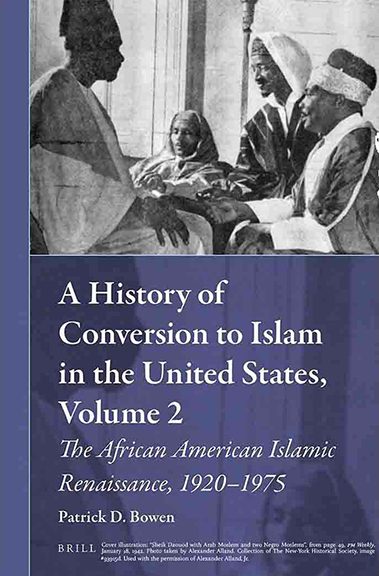
Patrick D. Bowen’s A History of Conversion to Islam in the United States, Volume 2: The African American Islamic Renaissance, 1920–1975 is a major study of twentieth-century African American engagement with Islam. The book is especially valuable because it treats conversion not as a single event or simple political reaction, but as a layered historical process shaped by race, religion, migration, print culture, leadership, and community formation.
A Documentary Study of African American Islamic History
Bowen’s central contribution is the scale of his documentation. Rather than limiting the story to the best-known public figures and organizations, he reconstructs a broader field of African American Islamic activity across several decades. The result is a work that places movements such as the Moorish Science Temple and the Nation of Islam within a larger ecosystem of religious searching, Black nationalism, Pan-African thought, missionary activity, urban community formation, and evolving claims about identity.
The book’s chronological frame, 1920 to 1975, is significant. It covers the rise of new Black Islamic movements, their growth through print and urban networks, and the transition into a wider Sunni-oriented period after the death of Elijah Muhammad. Bowen is careful to show that African American Islam did not develop in isolation, but in conversation with global Islam, American racial politics, and older memories of Muslim Africa.
Conversion as Process, Not Slogan
One of the strongest features of the study is Bowen’s refusal to reduce conversion to a single cause. In his account, Islam appealed to many African Americans because it offered religious discipline, historical recovery, racial dignity, communal structure, and an alternative language of belonging. These motivations could overlap, shift, and conflict depending on the organization, period, and individual convert.
This makes the book useful for IslamicASA readers because it helps explain how Islam became a living religious and cultural force in modern Black America while still leaving room for deeper investigation into earlier African Muslim presences in the Americas. Bowen’s work is strongest when read as a documentary map of twentieth-century movements rather than as the final word on every question of continuity, memory, or survival.
Interpretive Note: The book is especially important for distinguishing evidence-based history from simplified claims. Bowen does not deny the importance of earlier African Muslim presence, but his focus is the modern formation of African American Islamic movements and the historical conditions that made mass conversion possible in the twentieth century.
Strengths and Limitations
The volume’s greatest strength is its archival density. Bowen draws attention to lesser-known leaders, organizations, publications, and debates that are often overshadowed by the more familiar Nation of Islam narrative. For researchers, this makes the book valuable not only as a secondary study but also as a guide to sources, names, movements, and historical questions that deserve further investigation.
Its limitation is also connected to its ambition. The book is dense, detailed, and not always designed for casual reading. Readers looking for a short introductory overview may find the level of documentation demanding. However, for IslamicASA’s purposes, that density is an advantage: it gives the work lasting value as a reference point for the study of African American Islam.
Place Within IslamicASA Research
For IslamicASA, Bowen’s second volume is important because it helps situate twentieth-century African American Islam within the broader history of Islam in the Americas. It provides a necessary bridge between earlier studies of enslaved African Muslims, nineteenth-century encounters with the Muslim world, and the organized Islamic movements that reshaped Black religious life in the twentieth century.
The book should be read alongside primary sources, newspapers, organizational literature, autobiographies, and archival records. Its value lies not only in its argument, but in the way it opens a wider documentary trail for future research into Islam, race, religious identity, and historical memory in the United States.