
Abstract
Anthony (Antonio) van Salee remains one of the clearest documented figures through whom an Islamicate Atlantic presence can be traced into seventeenth-century colonial North America. This article reassesses his place in the history of New Netherland by placing primary colonial records, later genealogical transmission, and modern scholarship into a single evidentiary framework. Rather than claiming more than the record can sustain, it argues that van Salee’s case is historically significant precisely because it preserves a layered archive of origin, perception, adaptation, and inheritance. The records of New Amsterdam identify him in explicitly Islamicate terms, colonial land records confirm his status and residence, later family memory preserved a Qur’an in the descendant line, and the combined evidence complicates any simple narrative of total assimilation or clean religious rupture.
Introduction
The question of Muslim presence in early North America has too often been framed through either speculative expansion or excessive skepticism. One tendency treats any suggestive fragment as proof of enduring religious continuity; the other dismisses Islamicate presence unless a subject leaves behind explicit first-person testimony of doctrine or devotion. Both approaches distort the archive. A more reliable method begins with those individuals who are visibly present in the documentary record and asks what kinds of historical claims their records do—and do not—permit.
Anthony van Salee belongs in that category. He is not a shadowy figure reconstructed from rumor, nor a merely symbolic presence retrospectively inserted into colonial history. He appears in the administrative, legal, and land records of New Netherland often enough to permit a disciplined study of how a man of North African and Islamicate family background was perceived within a Dutch colonial world. The value of his case lies not in romantic singularity, but in the convergence of records that preserve his origin, social friction, property holding, institutional participation, and later descendant memory.
Salé, Murad Reis, and the Islamicate Atlantic
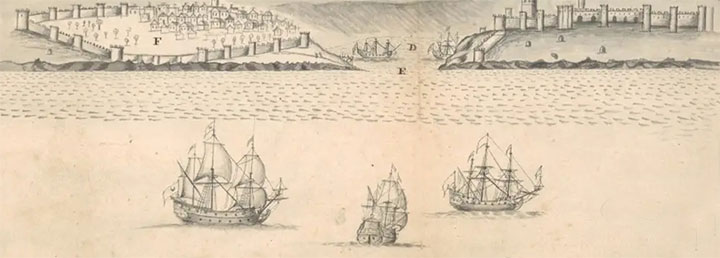
Anthony van Salee’s byname points directly to Salé, Morocco, one of the most important corsair centers of the early seventeenth century. He is widely understood to have been the son of Jan Janszoon, the Dutch mariner who converted to Islam and became known in North Africa as Murad Reis the Younger. Janszoon’s career was not marginal to the wider Mediterranean and Atlantic world. His name is associated with the 1627 raid on Iceland, a striking reminder that the Maghrebi corsair sphere was deeply entangled with northern European history as well as North African political structures.1
More recent scholarship on Dutch converts in North Africa has shown that figures such as Murad Reis cannot be reduced to the language of mere apostasy or piracy. They moved within diplomatic, commercial, and political networks linking the Dutch Republic to North African states, and their lives unsettled rigid assumptions about civilizational boundaries. In that context, the claim that Anthony van Salee emerged from a fully Islamicate environment is not rhetorical inflation. It is the most coherent reading of the evidence: a father embedded in North African Muslim political-maritime networks, a household formed through marriage to a Muslim woman from Morocco, and a son whose toponymic identity preserved the place of that upbringing.2
Care is still required. The exact formal rank of Murad Reis within Moroccan state structures is not documented in a way that resolves every later retelling. But the broader point does not depend on overclaiming titles. What matters is that Anthony van Salee did not arrive in the archive as simply another Dutch settler with an unusual surname. He carried into New Netherland a family history situated within the Islamicate Atlantic world, and the colonial record never fully erased that fact.
From the Maghreb to New Netherland
By the 1630s van Salee was established in New Netherland, where the surviving record places him squarely within the legal and territorial structures of the colony. The strongest evidence of durable settlement is his land patent on Long Island, recorded in the official colonial calendars. That grant does more than show presence; it shows recognition. To receive and hold land within the colony required a level of administrative standing that moves van Salee beyond anecdote and into the documented social fabric of New Netherland.3
His geographic footprint extended through New Amsterdam, Long Island, and later Gravesend. These were not abstract sites on a map but the core spaces in which colonial belonging was negotiated: courts, property lines, neighborhoods, and churches. Van Salee was part of that world, and the archive is strong enough to follow him within it.
Identity in the Court Record
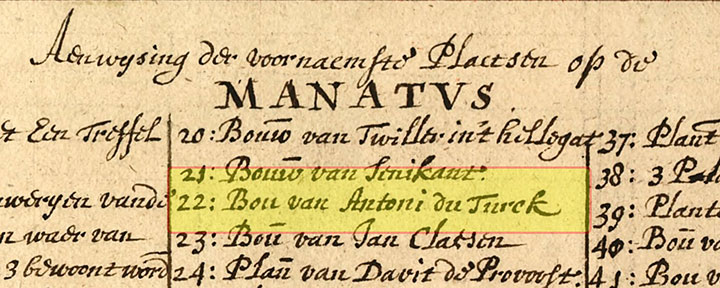
The most revealing evidence for van Salee’s life appears in the court records of New Amsterdam, where he is preserved not simply as a resident but as a repeatedly litigated and socially visible figure. In those records, he appears under the striking designation “Anthony the Turk.” That label must be understood in early modern usage: it did not function as a narrowly ethnographic term, but as a broad administrative and social marker applied to men associated with the Islamic world. Its importance lies precisely in its official character. The colonial record did not forget his origin; it encoded it.4
The legal record also reveals how this identity operated within colonial society. Van Salee was involved in disputes over debts, property, conduct, and neighborhood conflict. He was neither a passing outsider nor an unremarked settler. He was present enough, contentious enough, and legible enough to appear repeatedly in judicial process. The point is not to sensationalize his legal troubles, but to recognize what such records preserve: a colonial administration repeatedly naming and processing a man whose Islamicate background remained socially meaningful even as he functioned within Dutch institutions.
Gravesend and the Question of Stability
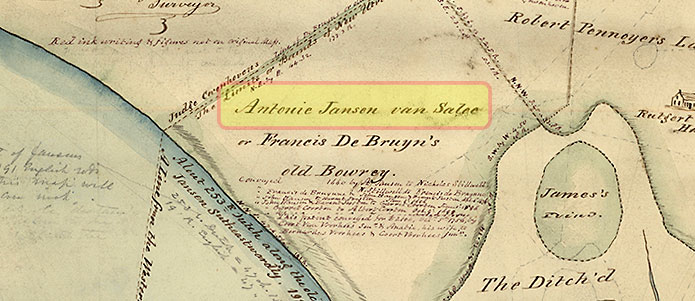
Any assessment of van Salee that stops with legal conflict misses the other half of the record: continuity. His later association with Gravesend indicates a degree of durable settlement that complicates portrayals of him as only disruptive or marginal. Gravesend represents not the disappearance of his earlier profile, but a shift in emphasis from judicial friction to long-term place-making. By following him there, the record allows us to see that his colonial life cannot be reduced to courtroom notoriety. He endured, held property, and remained part of the social geography of New Netherland.
The Fate of the Van Saleé Qur’an
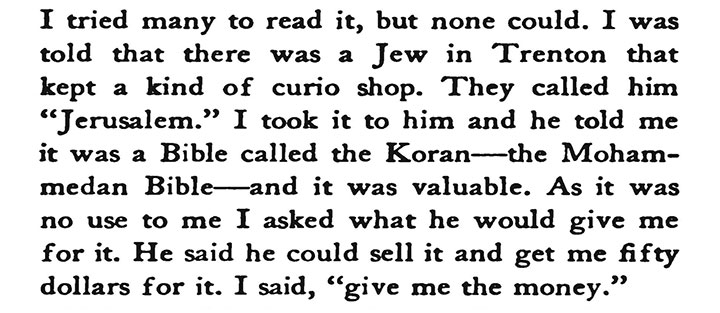
This account records not preservation, but loss. The Qur’an, having passed through the family line, was ultimately treated as an object without use or meaning, exchanged and effectively removed from the lineage.5
This recollection of the “van Saleé Koran” is significant because it preserves two historical realities at once. First, the object survived. A Qur’an remained within the descendant line long enough to be handed down and recognized as an unusual family possession. Second, the literacy and religious framework necessary to understand it had been lost. Descendants could preserve the artifact while no longer possessing the scriptural or linguistic continuity to interpret it on their own. That distinction is crucial. The story is not proof of unbroken Islamic practice in colonial New York. It is evidence of material inheritance outlasting theological continuity.
Precisely for that reason, the Qur’an account belongs near the interpretive end of the article rather than at its beginning. It gains meaning only when read against the earlier record. Colonial courts identified van Salee as “the Turk.” His family history points unmistakably toward the Islamicate Atlantic.6 A descendant household later preserved a Qur’an. Taken separately, each datum can be minimized. Read together, they make it much harder to sustain a model of total assimilation in which origin disappeared without residue.
Judicial Process, Institutional Participation, and Colonial Perception
Modern scholarship has helped clarify what the court record suggests but does not itself fully interpret. Leo Hershkowitz’s classic study of van Salee as “The Troublesome Turk” remains useful not because it exhausts the subject, but because it shows how judicial process in New Amsterdam reveals more than a string of petty disputes. The legal archive registers the colony’s encounter with a man who was at once incorporated and marked, resident and othered, socially embedded and persistently categorized. Judicial process, in this case, becomes a window into colonial perception as much as into colonial law.7
That perception did not exclude institutional participation. Van Salee’s family appears in Dutch Reformed Church records through the baptism of children, demonstrating that his household moved within the recognized ecclesiastical framework of the colony.8 Yet those church records do not resolve the question of personal conviction. They do not preserve a conversion narrative in his own voice, nor do they erase the legal record’s repeated identification of him in Islamicate terms. The result is a documentary tension historians should preserve rather than flatten: formal participation in colonial institutions coexisting with a remembered and recorded difference of origin.
Conclusion
Anthony van Salee’s significance lies not in the fantasy of recovering an untouched Muslim enclave in New Amsterdam, nor in collapsing his life into a simple story of conversion and disappearance. The archive supports neither extreme. What it does support is more historically valuable: a documented case in which Islamicate origin, colonial categorization, institutional adaptation, and descendant inheritance remain visible at different points in the record. This is precisely the kind of case that should anchor discussions of early Islamicate presence in the Americas, because it resists both exaggeration and erasure.
His biography begins in the orbit of Salé and the wider North African maritime world, a context that scholars of Barbary corsair activity have shown to be fully entangled with early modern Europe rather than isolated from it.9 It then enters New Netherland, where the colonial archive preserves him as landholder, litigant, and “Turk.” Finally, it extends beyond his own lifetime through the later memory of a descendant household preserving a Qur’an whose language it could no longer read. That final detail is not anecdotal ornament. It is the material trace of a historical process: objects can endure where confessional continuity does not, and memory can survive in partial, displaced, or damaged forms.
Van Salee therefore matters not as a token curiosity, but as evidence that early American colonial history was shaped by movements of people, identities, and religious cultures across the Atlantic and Mediterranean worlds. His case shows how the archive can preserve those crossings in uneven but durable ways. A rigorous history of Islamicate presence in the Americas must begin there—with individuals the record actually allows us to see, and with conclusions scaled to the evidence they leave behind.
Methodological Note
This article distinguishes between primary colonial documentation, later genealogical transmission, and modern secondary scholarship. Court and land records establish residence, legal identity, and social presence. Later family narratives are treated more cautiously, not as direct evidence for seventeenth-century belief or practice, but as evidence of descendant inheritance and memory. The argument therefore rests not on any single dramatic claim, but on the cumulative force of multiple source types read at their proper evidentiary level.
Footnotes
- Þorsteinn Helgason, The Corsairs’ Longest Voyage: The Turkish Raid in Iceland 1627, trans. Anna Yates and Jóna Ann Pétursdóttir. ↩
- Mercedes van Gelder, “The Republic’s Renegades: Dutch Converts to Islam in Seventeenth-Century Diplomatic Relations with North Africa,” Journal of Early Modern History 19, nos. 2–3 (2015): 175–198, https://doi.org/10.1163/15700658-12342456. ↩
- E. B. O’Callaghan, Calendar of Historical Manuscripts in the Office of the Secretary of State, New York, Part I (Albany, 1865). ↩
- E. B. O’Callaghan, ed., Records of New Netherland, vols. 1–2 (Albany: Weed, Parsons & Co., 1856–1858). ↩
- William Montgomery Clemens, ed., The Washington Ancestry and Records of the McClain, Johnson, and Forty Other Colonial American Families, p. 71. available here. ↩
- Brian A. Smith, D.C., The Most Remarkable Lives of Jan Jansen and his son Anthony (2013), available here; Brian A. Smith, D.C., Footprints in the Sand: Ruling Dynasties of the Maghreb from the 7th to 17th centuries, preview available here. ↩
- Leo Hershkowitz, “The Troublesome Turk: An Illustration of Judicial Process in New Amsterdam,” New York History 46, no. 4 (October 1965): 299–310, http://www.jstor.org/stable/23162613. ↩
- Kenneth Scott and Kenn Stryker-Rodda, eds., New York Historical Manuscripts: Dutch (Baltimore: Genealogical Publishing Co., 1974). ↩
- Adrian Tinniswood, Pirates of Barbary: Corsairs, Conquests and Captivity in the Seventeenth-Century Mediterranean (2010). ↩