
Abstract
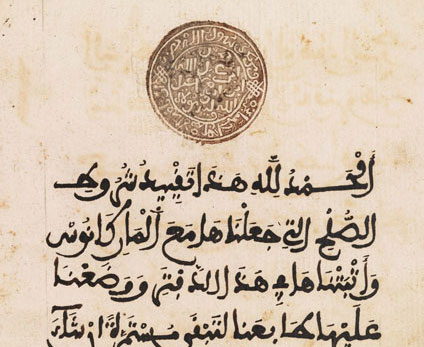
The Moroccan-American Treaty of Peace and Friendship occupies a singular place in the diplomatic formation of the early United States. Concluded in 1786 and ratified in 1787, it formalized relations between the United States and the Moroccan Empire under Sultan Muhammad III. Its importance lies not only in its longevity, but in the character of the documentary record itself: the treaty originated in Arabic, moved through Moroccan administrative channels, was approved by American ministers in Europe, and continued to be sustained through later diplomatic correspondence. Read as a documentary chain rather than as a single text, the treaty reveals an early American encounter with Islamic statecraft, translation, and transatlantic diplomacy at a high political level.
Introduction
The Moroccan-American Treaty of Peace and Friendship is often cited as the oldest unbroken treaty relationship in United States history, but that description alone does not capture its deeper historical importance.2 The treaty belongs to the foundational period of United States foreign relations and demonstrates that one of the republic’s earliest formal international relationships was conducted with a Muslim sovereign power through Arabic-language state documentation, European intermediaries, and carefully managed translation.
Properly understood, the treaty should not be reduced to a symbolic anecdote about early friendship. It was a legal and diplomatic instrument created within the Moroccan chancery tradition, transmitted across the Atlantic world, and executed by senior American representatives whose authority was sufficient to bind the new republic pending ratification. The surviving texts and related letters show not only the making of a treaty, but the operation of an ongoing diplomatic relationship.3
Moroccan Recognition and Diplomatic Context
Morocco’s engagement with the United States predated the treaty itself. In 1777, Sultan Muhammad III opened Moroccan ports to American vessels, effectively extending recognition to the new republic at a moment when the United States was still struggling to secure its position in the international order.4 This act was not merely ceremonial. It reflected Moroccan efforts to manage maritime traffic, regulate commercial access, and draw a new Atlantic actor into a defined diplomatic framework.
The benefits to Morocco were concrete. Recognition offered an opportunity to diversify external relations beyond the dominant imperial rivalries of Britain, France, and Spain; to place American shipping within a recognized structure of protection and obligation; and to strengthen Morocco’s own autonomy by dealing directly with the United States rather than through European mediation alone. In this sense, recognition served commerce, maritime security, and sovereignty at once.
On the Moroccan side, the treaty process was carried out through identifiable officials rather than through abstraction. Among the men associated with securing the treaty under Sultan Muhammad III was Tahar ben Abdelhak Fennish, whose role highlights the structured nature of Moroccan diplomacy in the late eighteenth century.5 The agreement was therefore the product of coordinated state action on both sides, not an improvised exchange.
Transatlantic Execution, Translation, and Ratification
The execution of the treaty in Europe reflects the geographic realities of early American diplomacy. Lacking a permanent diplomatic presence in North Africa, the United States relied on its ministers plenipotentiary—John Adams in London and Thomas Jefferson in Paris—to approve and transmit the agreement. These were not minor envoys: Adams would become the second President of the United States and Jefferson the third. Their involvement signals the high political importance assigned to relations with Morocco by the early republic.8
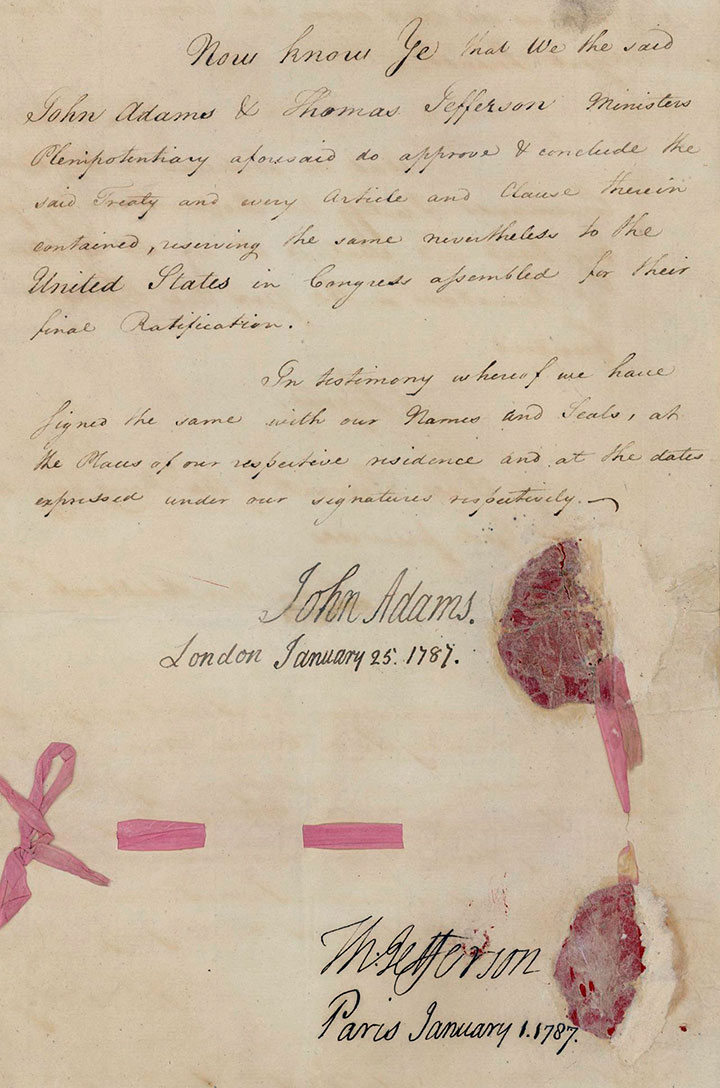
The title “Minister Plenipotentiary” carried specific legal weight. Derived from the Latin plenus (“full”) and potens (“powerful”), it referred to a diplomat vested with full powers to negotiate and bind his government in treaty matters, pending final sovereign ratification. The separate signatures—Jefferson in Paris on 1 January 1787 and Adams in London on 25 January 1787—also reveal the distributed character of early American diplomacy, which operated across multiple European capitals rather than through a centralized foreign service.
Although the Arabic text constituted the originating instrument, the United States ratified the treaty through an English translation. The coexistence of Arabic original and English ratified text illustrates a broader diplomatic reality of the eighteenth century: translation, rather than linguistic uniformity, often made international law workable across political worlds.10
Preservation and Publication
The Arabic manuscript and its related diplomatic materials survived through archival preservation and later printed reproduction. The most important modern bridge to the original treaty is David Hunter Miller’s edition of Treaties and Other International Acts of the United States of America, which reproduces the Arabic treaty in facsimile and remains the standard printed reference for the text.11
This layered documentary history matters. The treaty is known today not only because it existed, but because it was recopied, translated, archived, printed, and recontextualized across more than a century. Each stage of preservation helped carry an eighteenth-century Moroccan state document into modern historical scholarship.
Diplomatic Continuity in Correspondence
The treaty did not conclude the diplomatic relationship; it initiated a correspondence that reveals the continuing operation of mutual recognition. Letters exchanged between the American executive and the Moroccan court reaffirmed the language of peace, friendship, and sovereign respect established in the treaty itself. These letters are valuable not as ornament, but as evidence that the agreement became a living diplomatic relationship rather than remaining a static text.
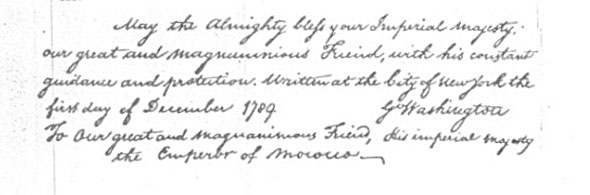
Washington’s letter is revealing in its form and tone. Addressing the Moroccan ruler as a “great and magnanimous Friend,” it presents the relationship in a vocabulary of parity, respect, and mutual esteem rather than subordination. That language is especially important in light of later colonial discourses; here, by contrast, the United States is engaging a Muslim sovereign within a framework of diplomatic reciprocity.
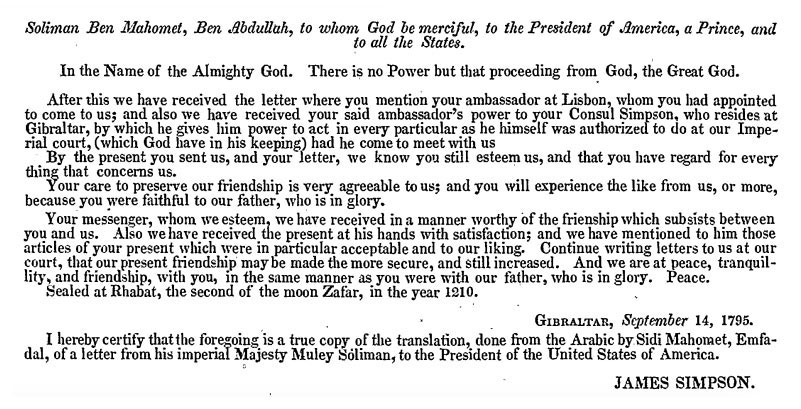
The English translation of the Sultan’s letter completes the diplomatic circuit preserved in the documentary record: treaty, execution, American presidential correspondence, and Moroccan reply. Particularly notable is the emphasis on friendship, continuity, and secure relations. The translation also highlights the practical role of interpreters and consular intermediaries in sustaining clarity between Arabic and English diplomatic worlds.
Legal and Historical Significance
The treaty established mutual peace and friendship, protections for vessels and merchants, and a framework for legal security between the two states.14 More importantly for the history of Islam in the Americas, it demonstrates three larger points:
- The United States entered into formal relations with a Muslim polity through Arabic-language statecraft.
- Islamic diplomatic conventions were directly embedded in an early American international agreement.
- Morocco was not a passive background actor, but a sovereign participant shaping the legal terms of the relationship.
Seen this way, the treaty is not only an early American milestone. It is also evidence that the fledgling United States entered an existing diplomatic order in which non-European powers, including Morocco, possessed the authority to recognize, regulate, and engage the new republic on their own terms.
Conclusion
The Moroccan-American Treaty of Peace and Friendship stands as a rare Arabic-origin diplomatic instrument within the formative period of United States foreign relations. Its manuscript form, chancery style, transmission history, and associated letters reveal a layered story of sovereignty, translation, legal authority, and diplomatic continuity.
For IASA’s purposes, the treaty matters because it documents state-level engagement between the United States and a Muslim power through Islamic administrative forms. It demonstrates that Islam and Muslims were present in the documentary foundations of the Atlantic world not only through migration, captivity, or private religious life, but also through sovereign diplomacy. That is what gives the treaty its enduring value as both a historical and an archival object.
Footnotes
- David Hunter Miller, ed., Treaties and Other International Acts of the United States of America, vol. 2 (Washington, D.C.: U.S. Government Printing Office, 1931), 185–227, HathiTrust Digital Library. ↩
- U.S. Department of State, Office of the Historian, “Morocco,” on the treaty as the longest unbroken treaty relationship in U.S. history. ↩
- Miller, ed., Treaties and Other International Acts of the United States of America, vol. 2, Morocco notes and documentary materials, HathiTrust Digital Library; see also the Avalon Project, “The Barbary Treaties 1786–1816: Treaty with Morocco—Notes.” ↩
- U.S. Department of State, Office of the Historian, “Morocco,”; see also the editorial introduction in the Adams Papers, “The Moroccan-American Treaty.” ↩
- For Tahar ben Abdelhak Fennish’s role in completing and certifying the treaty materials, see the Avalon Project, “Treaty with Morocco—Additional Article,” and Miller, ed., Treaties and Other International Acts of the United States of America, vol. 2, Morocco section, HathiTrust Digital Library. ↩
- Miller, ed., Treaties and Other International Acts of the United States of America, vol. 2, 185–227, HathiTrust Digital Library; see also the Avalon Project, “Treaty with Morocco—The English Translation of 1786.” ↩
- The Adams Papers, Massachusetts Historical Society, Thomas Barclay to the American Commissioners, 2 October 1786, referring to “a Book containing the original Treaty in Arabic.” ↩
- For Adams and Jefferson as the American ministers plenipotentiary involved in the treaty process and later the second and third Presidents of the United States, see The White House, “John Adams” and The White House, “Thomas Jefferson.” ↩
- Signature page of the treaty approval materials showing Thomas Jefferson signing at Paris, 1 January 1787, and John Adams signing at London, 25 January 1787. ↩
- For the English treaty text and its ratified form, see the Avalon Project, “Treaty with Morocco, June 28 and July 15, 1786,” together with Miller, ed., Treaties and Other International Acts of the United States of America, vol. 2, HathiTrust Digital Library. ↩
- Miller, ed., Treaties and Other International Acts of the United States of America, vol. 2, facsimile reproduction of the Arabic manuscript, HathiTrust Digital Library. ↩
- George Washington, Letter to Mohammed ben Abdallah, 1 December 1789, George Washington Papers, Library of Congress; digital image via Wikimedia Commons, file page. ↩
- American State Papers, Class I, Foreign Relations, vol. 1, 526, English translation of a letter from Sultan Sidi Mohammed ben Abdallah to George Washington, Library of Congress scan of volume 1. ↩
- For the treaty provisions and their legal framework, see Miller, ed., Treaties and Other International Acts of the United States of America, vol. 2, HathiTrust Digital Library, and the Avalon Project, “Treaty with Morocco, June 28 and July 15, 1786.” ↩