
Abstract
The Highland Park “Moslem Mosque,” erected in 1921 in Highland Park, Michigan, occupies an important place in the documentary history of Islam in the United States. Contemporary reporting and later historical discussion treated the building as an unprecedented public mosque for a growing Muslim immigrant community in the Detroit district. This study reassesses the mosque through contemporaneous printed evidence, especially Samuel M. Zwemer’s 1921 article in the Missionary Review of the World, and situates it within the migration, labor, and institutional development of early twentieth-century Detroit-area Muslims. Although the mosque was short-lived and later overshadowed by more durable institutions, the surviving record shows that it marked an early transition from informal prayer and domestic religious life to visible public Islamic institutional form in America.
Introduction
The short-lived mosque erected in Highland Park, Michigan, in 1921 occupies a central place in the documentary history of Islam in the United States. Although later public memory attached the title of “first mosque” to other communities and surviving structures, contemporary reporting from the period surrounding the Highland Park project treated it as an unprecedented undertaking: a public mosque built for a growing Muslim immigrant community in the industrial Detroit district. 2 The surviving record is especially important because it preserves not only retrospective claims, but contemporary evidence from the very moment the mosque entered public view.
The Highland Park mosque emerged from a specific historical setting. In the early twentieth century, Muslim immigrants from Ottoman Syria and adjacent regions were drawn to southeast Michigan by industrial employment, particularly the Ford complex at Highland Park. By the time the mosque project was underway, Detroit-area Muslims had achieved a sufficient local concentration to imagine a formal institution rather than relying exclusively on prayer in homes, rented rooms, or other improvised settings. 3 The Highland Park building therefore marked a transition from dispersed religious observance to visible institutional form.
Mohammed Karoub and the Mosque Project
The central lay figure in the project was Mohammed Karoub, a Syrian immigrant associated with real-estate development in Highland Park. Contemporary and later accounts agree that Karoub served as the driving force behind the effort and that the mosque stood on Victor Street in Highland Park near the Ford industrial zone. 4 Reporting from the period indicates that funds were gathered not only locally but from supporters in other parts of the United States and abroad, suggesting that the mosque was imagined as more than a neighborhood initiative. It was presented as a symbol of Muslim presence in America.
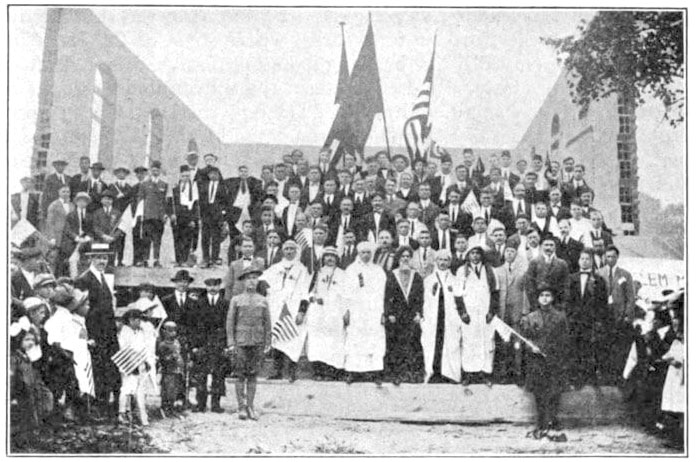
Construction began in 1921, and the opening was tied to Eid al-Fitr observances in June of that year. The image reproduced in Figure 1 is especially valuable because it places the mosque within a communal celebration rather than merely as an isolated building. It associates the scene directly with a festival gathering at the Karoub mosque. As a visual document, it shows that the building was understood at the time not simply as private property or an informal prayer hall, but as the public center of a self-conscious Muslim community. 5
Zwemer’s 1921 Article and the “First Mosque” Claim
One of the most important contemporary witnesses is Samuel M. Zwemer’s article, “A Mohammedan Mosque at Detroit, Mich.,” published in the Missionary Review of the World in October 1921. Whatever one makes of Zwemer’s broader interpretive framework, the article is indispensable because it records how the project appeared to a contemporary observer at the moment of the mosque’s public emergence. That matters historiographically. It is one thing for later writers to retroactively assign priority; it is another for a 1921 source to single out Detroit as the location of an exceptional public mosque.
Zwemer wrote that American Muslims “have no public mosques, with one exception. At Detroit, Mich., the first mosque was built …” 6 This sentence does not settle every later debate about what should count as the “first mosque” in America. It does, however, establish that a contemporary printed source regarded the Highland Park mosque as the singular public exception and, more strongly, as “the first mosque” built there. For historical writing grounded in the documentary record, that is a significant distinction.
Institutional Visibility in an Industrial Landscape
The Highland Park mosque must be understood within the industrial geography of early twentieth-century Detroit. Its location near the Ford Highland Park plant linked Islamic institutional formation to immigrant labor, wage work, and urban concentration. The mosque was not an isolated frontier survival but a built response to the pressures and possibilities of mass industrial migration. In that sense, Highland Park stands at the beginning of a specifically American pattern: Muslims establishing religious institutions in close relation to labor markets, ethnic settlement, and metropolitan growth. 7
The documentary record also suggests that the mosque’s congregation and leadership were internally diverse. The Highland Park community appointed a Sunni imam, Hussein Karoub, and a Shi‘i imam, Kalil Bazzy; not long after, the Ahmadiyya missionary Mufti Muhammad Sadiq also joined the mosque’s unusually layered leadership structure. 8 Oxford’s reconstruction of the early community notes that the first religious services in June 1921 were held with all three imams in attendance and that sixteen nationalities were represented in the congregation. 9 The Ahmadiyya paper The Moslem Sunrise, issue no. 2 (October 1921), also discussed the mosque and reproduced images on pp. 30–31, presenting the Karoub family in prominent terms and linking the project to Mufti Sadiq’s wider mission. 10 That combination of Sunni, Shi‘i, and Ahmadi participation gave the mosque an importance beyond its brief lifespan. It represented one of the earliest known attempts to institutionalize Islam in the United States as a visible, organized communal presence rather than as a purely domestic or improvised practice.
Decline, Dissension, and Historical Afterlife
Yet the Highland Park mosque proved fragile. By the mid-1920s, newspaper reporting described the building as a site of disappointment and internal dissension. A 1924 Detroit Free Press account presented the project as a melancholy ruin, emphasizing conflict within the congregation and the failure of the original promise. 11 Later accounts connect the mosque’s decline to noise, location, finances, factional dispute, and the broader demographic movement of Muslim workers away from Highland Park and into other Detroit-area communities.
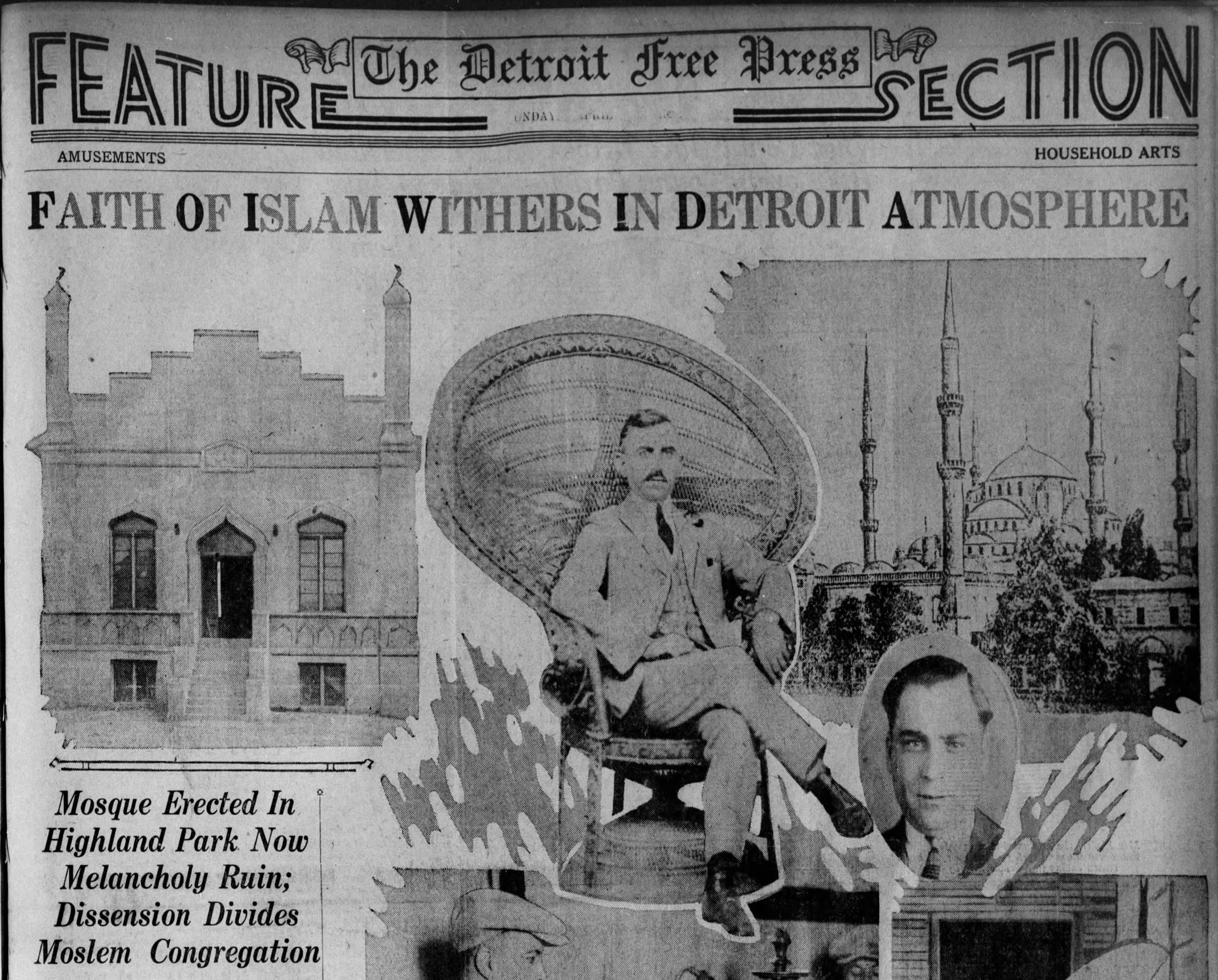
The building’s short life contributed to a peculiar historical afterlife. Because it did not survive as a continuously functioning institution, later public narratives often shifted attention to more durable sites such as the Ross mosque in North Dakota or the Mother Mosque in Cedar Rapids. The result was not merely a change in emphasis but a distortion of chronology. Highland Park’s disappearance from the landscape made it easier for later memory to privilege survival over priority. That is precisely why the surviving 1921 documentation is so valuable.
Conclusion
The importance of the Highland Park mosque does not rest solely on whether one adopts the strongest possible version of the “first mosque in America” claim. Its deeper significance lies in what the documentary record clearly establishes: by 1921, a Muslim immigrant community in the Detroit area had moved to construct a public mosque, celebrate Eid in front of it, and present itself in print as a visible Islamic presence in the United States. In the history of Islam in America, that threshold matters.
Highland Park should therefore be treated not as a curiosity eclipsed by later and more durable institutions, but as one of the earliest and most important experiments in the public institutionalization of Islam in the United States. The mosque’s physical disappearance does not diminish its historical force. On the contrary, it makes the surviving printed record all the more essential.
Methodological Note
This article is based on contemporaneous printed evidence together with later historical discussion of the Highland Park mosque. Claims concerning the contemporary “first mosque” language rely primarily on Samuel M. Zwemer’s 1921 article in the Missionary Review of the World. Context concerning Detroit-area migration, labor, and the later fate of the mosque is used as interpretive support and should be supplemented with local newspaper and archival research in any expanded scholarly edition.
Footnotes
- Samuel M. Zwemer, “A Mohammedan Mosque at Detroit, Mich.,” Missionary Review of the World 44 (October 1921): 787, photograph and caption, HathiTrust Digital Library. Zwemer, frequently described as the “Apostle to Islam,” was a leading Protestant missionary focused on the conversion of Muslims; see, for example, J. Christy Wilson, Jr., Apostle to Islam: A Biography of Samuel M. Zwemer (Grand Rapids: Baker Book House, 1952), Internet Archive; see also Wikipedia. ↩
- Samuel M. Zwemer, “A Mohammedan Mosque at Detroit, Mich.,” Missionary Review of the World 44 (October 1921): 787–791, HathiTrust Digital Library. ↩
- “The Tragedy of Highland Park,” Moving Stories: Muslim Communities in Britain and America, University of Oxford, movingstories.history.ox.ac.uk. ↩
- Detroit1701, “Highland Park Muslim Mosque,” detroit1701.org. ↩
- Zwemer, “A Mohammedan Mosque at Detroit, Mich.,” 787, HathiTrust Digital Library. ↩
- Zwemer, “A Mohammedan Mosque at Detroit, Mich.,” 787, HathiTrust Digital Library. ↩
- “Was Highland Park the Home of America’s First Mosque? It’s Complicated,” Michigan Public, August 16, 2021, michiganpublic.org. ↩
- “The Tragedy of Highland Park,” Moving Stories: Muslim Communities in Britain and America, University of Oxford, esp. the sections “The Imams of Highland Park” and the discussion of Bazzy, Karoub, and Mufti Muhammad Sadiq, movingstories.history.ox.ac.uk. ↩
- “The Tragedy of Highland Park,” Moving Stories: Muslim Communities in Britain and America, University of Oxford, noting that the first services took place in June 1921 with all three imams present and that sixteen nationalities were represented in the congregation, movingstories.history.ox.ac.uk. ↩
- The Moslem Sunrise 1, no. 2 (October 1921): 30–31, including the illustration and notice on the Highland Park mosque and the Karoub family, PDF. See also opening lines identifying the issue as “No. 2 … October, 1921” and the mosque note on p. 31. ↩
- Carl Muller, “Mosque Erected in Highland Park Now Melancholy Ruin; Dissension Divides Moslem Congregation,” Detroit Free Press, April 20, 1924, as cited in Detroit1701, “Highland Park Muslim Mosque,” detroit1701.org. ↩
- “Faith of Islam Withers in Detroit Atmosphere: Mosque Erected in Highland Park Now Melancholy Ruin; Dissension Divides Moslem Congregation,” Detroit Free Press (Detroit, Michigan), April 20, 1924, p. 53, Newspapers.com. ↩