
Abstract
The claim that James and Agnes Love of Scotland were the first Muslims in Canada has been widely repeated in secondary literature. A review of the original census images from 1851 through 1911, however, reveals no consistent evidence to support this assertion. Instead, the record points to a Presbyterian household, with a single anomalous entry in 1871. While the 1871 census does contain individuals identified as “Mohammedan,” the evidentiary basis for identifying the Love family as such remains unclear. This case illustrates how historical claims may be shaped by incomplete citation, interpretive ambiguity, and repetition across secondary sources.
Introduction
James and Agnes Love are frequently identified in secondary sources as the first recorded Muslims in Canada. Despite the persistence of this claim, it has rarely been tested against the full range of available census evidence. This study examines the original census images across multiple decades in order to evaluate whether the claim can be sustained. 1
On Earlier Muslim Presence and the Limits of the Census
The identification of James and Agnes Love as the “first Muslims in Canada” raises a broader question: whether Muslim presence in Canada predates the 1871 census altogether. Even if the Love and Simons households are accepted as Muslim, the available evidence suggests that Muslims were present in Canada earlier.
One documented example is Mahommah Gardo Baquaqua, a West African Muslim who, after escaping enslavement in Brazil, resided in Chatham in the early 1850s, approximately between 1853 and 1854. 2 His presence is attested in abolitionist records and in his own narrative. 3
Baquaqua would not appear in the Canadian census, as his residence in Canada did not coincide with a census year. His case therefore illustrates an important limitation of census-based approaches: absence from the census does not imply absence from the country.
Census Record (1851–1911)
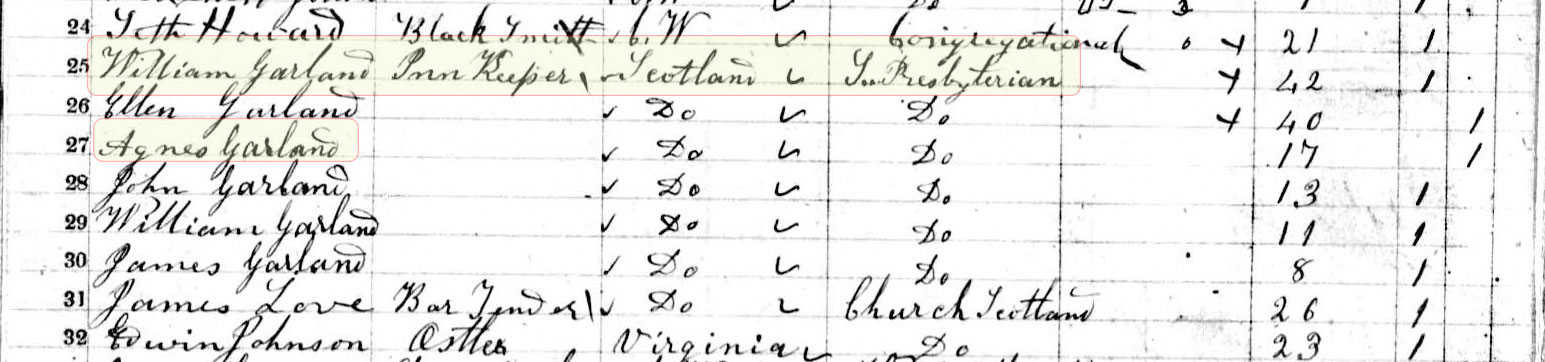
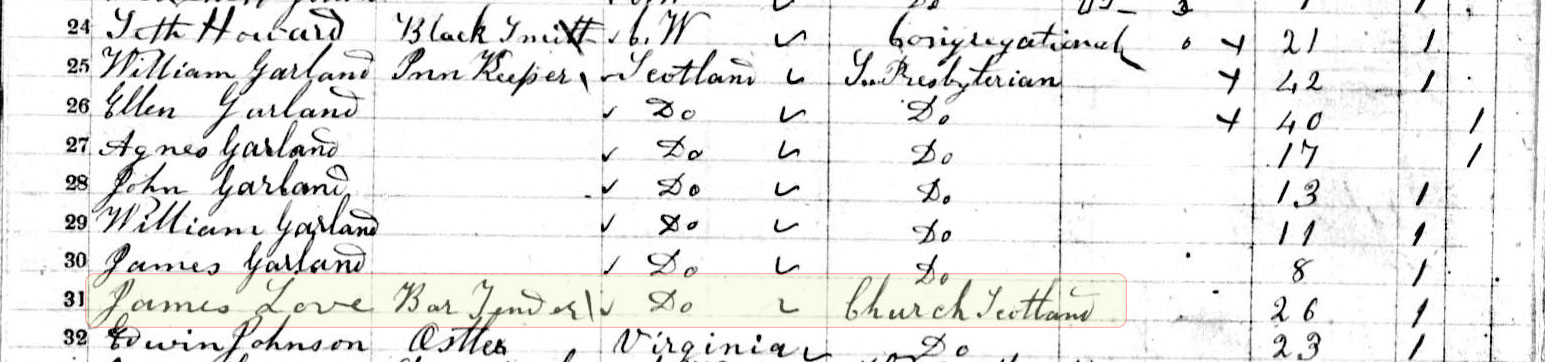
The 1851 census records Agnes Garland living with her parents, all identified as Presbyterian (Fig. 1). 4 In the same year, James Love appears separately, with his religion given as Church of Scotland (Fig. 2). 5 Both are listed as single. Agnes’s father is recorded as an innkeeper, while James Love is identified as a bartender.
By 1861, the Love household is clearly identified as Presbyterian (Fig. 3). 6

The 1871 Anomaly
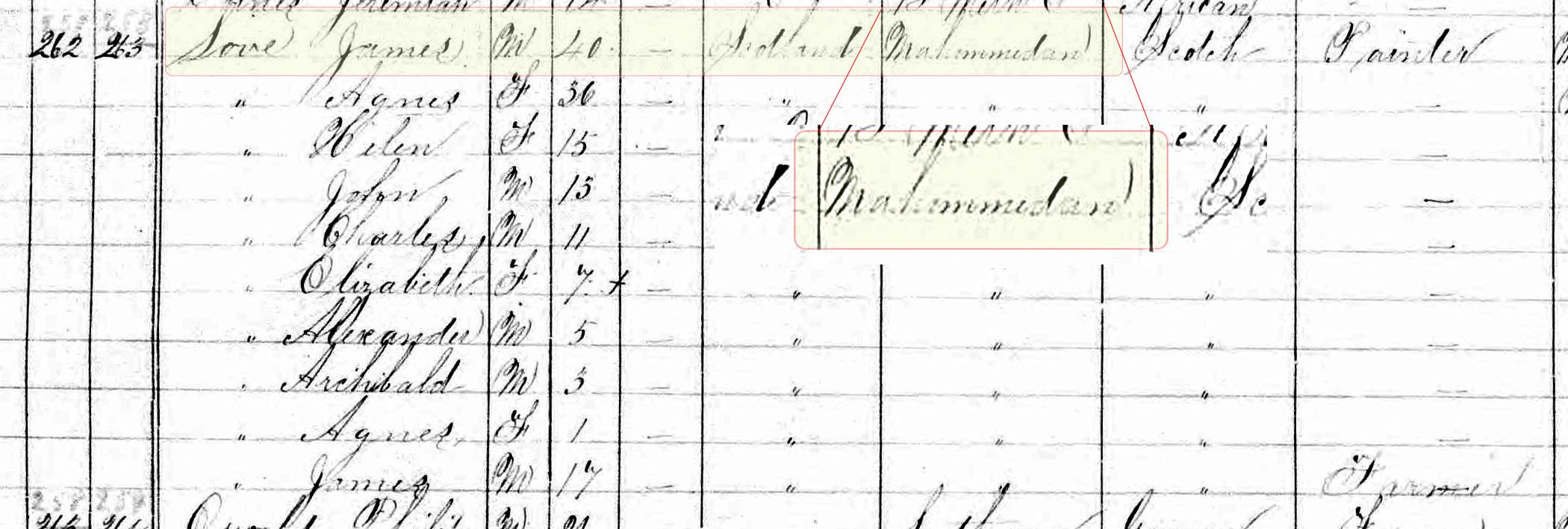
The only deviation appears in the 1871 census, where the Love household is recorded under the designation “Mohammedan” (Fig. 4). 7 This entry stands in direct contradiction to every other census record associated with the family.
A close reading of the original census image (Fig. 4) highlights the limitations of relying on a single entry of this kind.
Continuation of the Love Family Record
In 1881, the Love family is again identified as Canadian Presbyterian (Fig. 5). 8 In 1891, their religion is entered as Presbyterian or Free Church (Fig. 6). 9 The pattern continues in 1901 (Fig. 7) 10 and 1911 (Fig. 8). 11
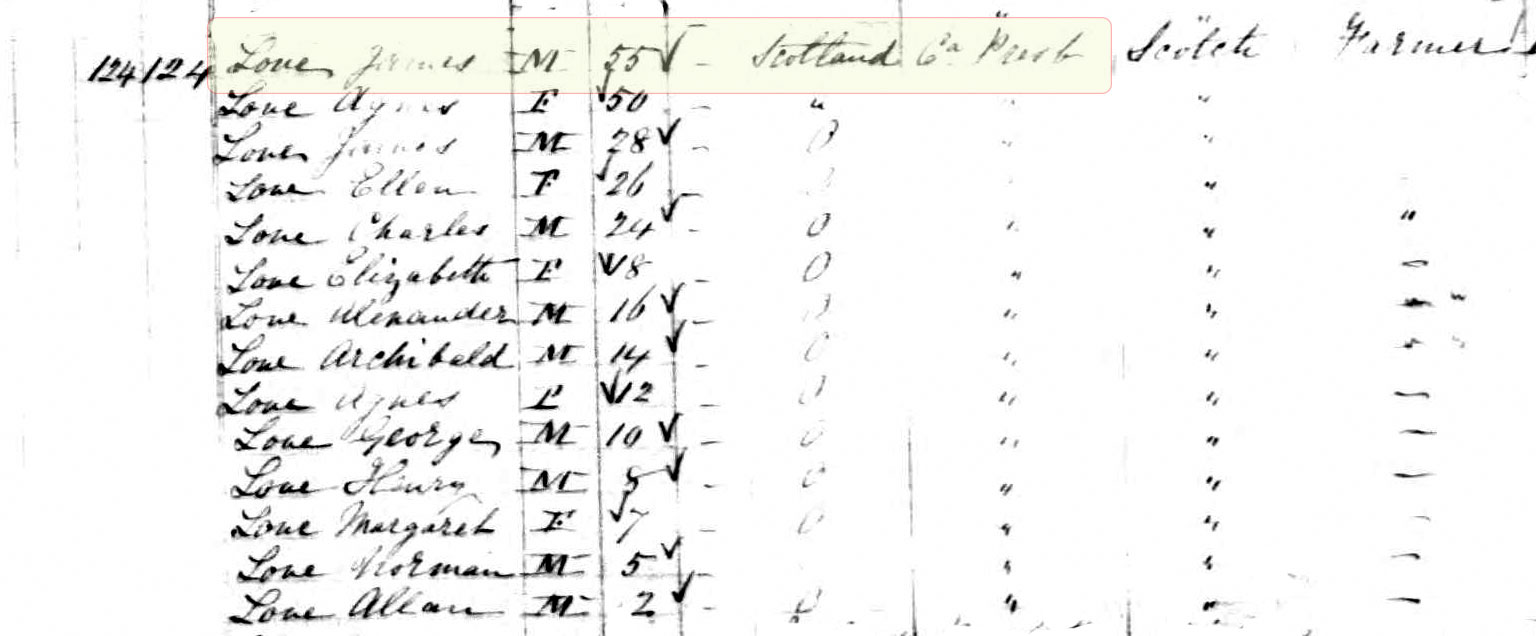
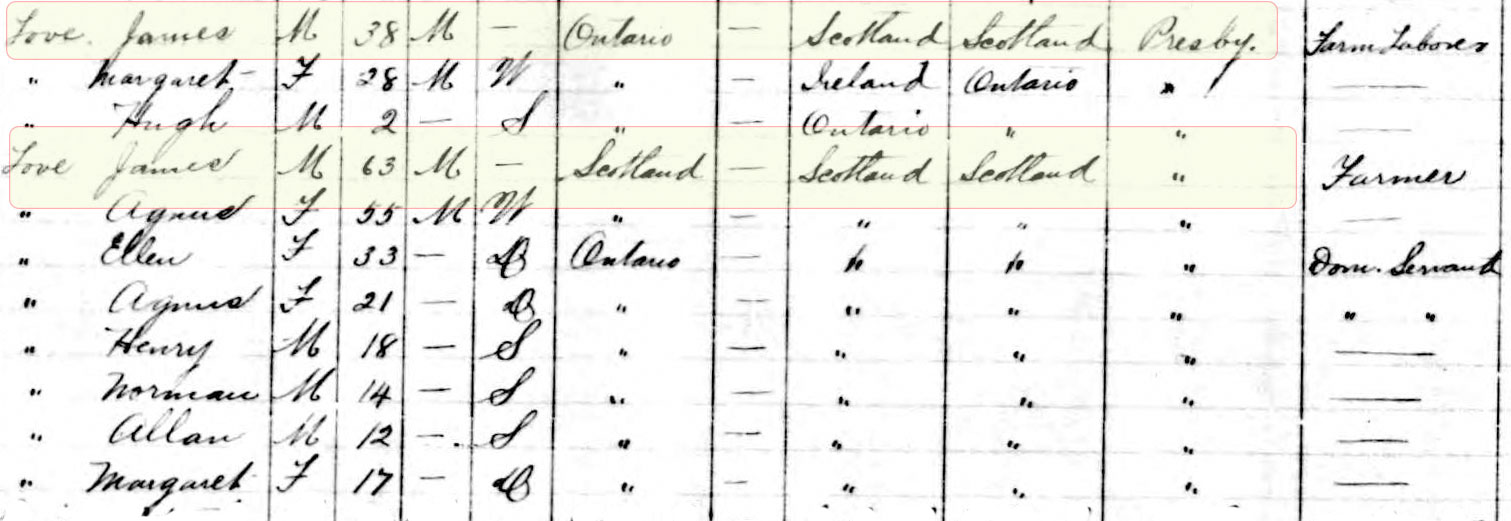


Across six decades of census data, the household’s religious affiliation is stable and clearly within the Scottish Presbyterian tradition, apart from the single anomalous 1871 entry.
On the Identification of the Simons Household
In addition to the Love family, earlier scholarship identifies John and Martha Simon as part of the Muslim population in 1871. 12 A re-examination of the census images confirms the presence of this household; however, the surname appears in the original record as Simons, not Simon.
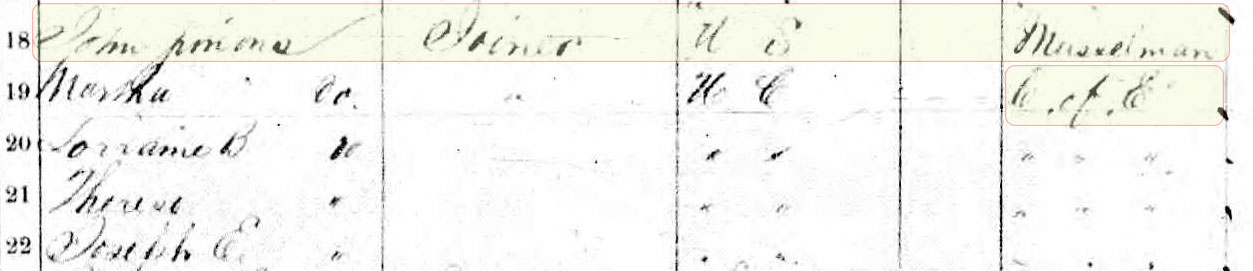
When read against the 1861 census, the household appears more complex. John Simons is listed with the religion “Musselman,” while his wife and children are recorded as Church of England (Fig. 9). 13 This earlier entry indicates that the divergence in religious designation within the household was not confined to 1871.
The 1871 census lists John Simons and Martha Simons with religion recorded as “Mohammedan” (Fig. 10). 14 However, on the following page within the same scan, Emanuel Simons is recorded as born in Canada, with religion listed as “Church of England,” and occupation as store clerk. 15
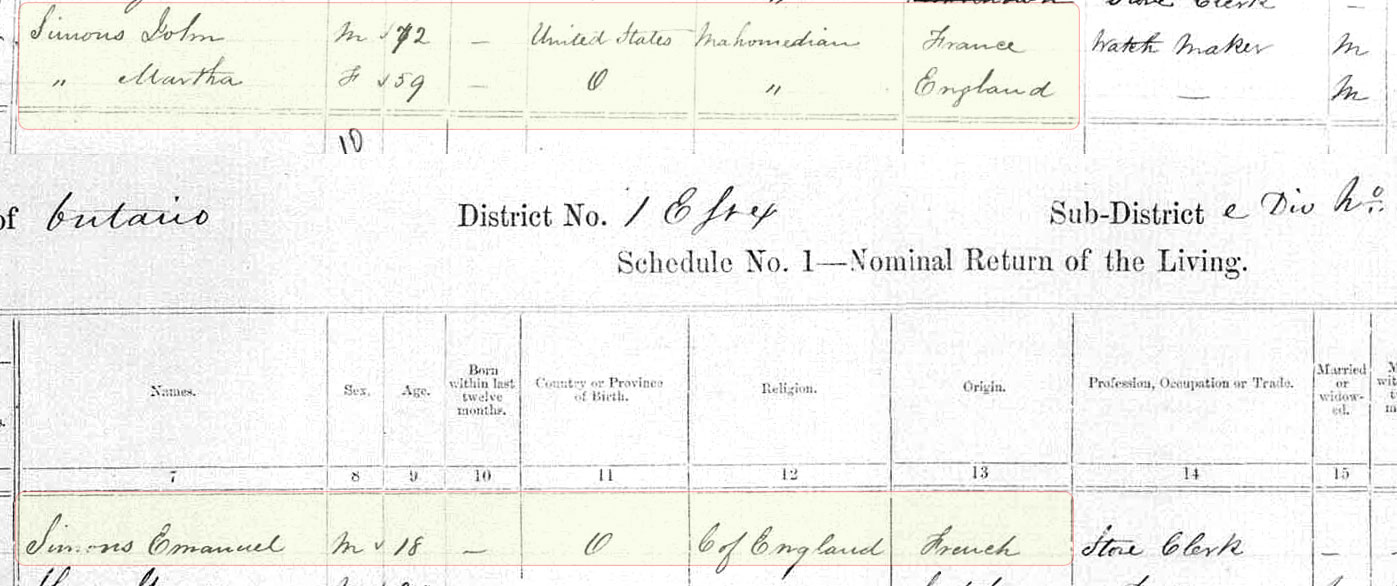
Additional documentary evidence reinforces this pattern. Marriage records for three of John Simons’s children identify them as affiliated with the Church of England. 16 Taken together, the evidence suggests a mixed household in which John himself may have been identified as Muslim, while other members of the family were consistently recorded within Anglican affiliation.
This pattern distinguishes the Simons household from the Love family.
On Earlier Scholarship: Hamdani, Haddad, and the Census Record
The attribution of James and Agnes Love as the first Muslims in Canada appears to originate in Daood Hassan Hamdani’s 1984 article Muslims in the Canadian Mosaic. 17 Hamdani states that his conclusions are based on handwritten manuscripts of the 1871 Census of Canada but does not provide specific archival references.
Earlier, Yvonne Yazbeck Haddad noted that “Census Canada for 1871 shows that there were 13 Muslims in the country that year,” citing Muhammad Said Massoud. 18 Hamdani challenges her interpretation of later censuses, arguing that Muslims were not enumerated as a separate category. 19
While both authors draw on census material, neither provides sufficient detail to allow the figure to be independently reconstructed.
Beyond 1871: Evidence from the 1881 Census
The 1881 census provides a clearer example of a Muslim individual in Canada: John Mahomet, age 47, born in India, religion Mahometan, with occupation listed as seaman (Fig. 11). 20

John Mahomet was not an isolated case. By the late nineteenth century, Muslim individuals were arriving in Canada from different parts of the Muslim world, reflecting broader patterns of mobility across the British Empire and beyond.
On the “13 Muslims” Claim
The frequently cited figure of thirteen Muslims in the 1871 census appears to have a partial basis in the record. Twelve individuals can be provisionally identified: ten members of the Love household (Fig. 4) and John and Martha Simons (Fig. 6).
A systematic search of the 1871 census database under the religion field—using variant spellings including “Mohammedan,” “Mohammadan,” “Mohamet,” and “Mohammadian”—does not yield additional clearly identifiable entries.21
Conclusion
The census record does not support the conclusion that James and Agnes Love were Muslims. Instead, it documents a consistently Presbyterian household, with a single anomalous entry in 1871 that is not corroborated elsewhere.
The persistence of the claim appears to result from a citation chain in which secondary sources repeat earlier assertions without direct reference to the underlying census images. Over time, repetition has elevated a weakly supported interpretation into an accepted historical claim.22 A return to the primary record demonstrates the importance of verifying widely circulated claims against original sources rather than relying on inherited conclusions.Methodological Note
All conclusions presented in this study are derived from direct examination of original census images (1851–1911), ensuring that the analysis is grounded in primary evidence rather than transcriptions or secondary interpretations.
Footnotes
- Survey of commonly cited secondary sources identifying the Love family as early Muslims in Canada. “First Canadian Muslims,” Canadian Muslims (eCampusOntario Pressbooks), accessed April 12, 2026, https://ecampusontario.pressbooks.pub/canadianmuslims/chapter/first-canadian-muslims/ ; “History Month Canada,” About Islam, accessed April 12, 2026, https://aboutislam.net/muslim-issues/n-america/history-month-canada/ ; Canadian Muslim Excellence: A Time to Celebrate, Educate, and Reflect, Journal of Teaching and Learning 18, no. 2 (2024): 37–54, https://doi.org/10.22329/jtl.v18i2.8798 . ↩
- Narrative accounts place Baquaqua in Chatham, Ontario, c. 1853–1854.↩
- Mahommah G. Baquaqua, An Interesting Narrative (Detroit, 1854); forthcoming IASA article.↩
- 1851 Census of Canada East, Canada West, New Brunswick, and Nova Scotia, Wentworth, Canada West (Ontario), Schedule A, roll C-11758, p. 1, line 31; Agnes Garland household image, split from the same census page as James Love. Ancestry.com, database online (Provo, UT: Ancestry.com Operations Inc, 2006), from Library and Archives Canada.↩
- 1851 Census of Canada East, Canada West, New Brunswick, and Nova Scotia, Wentworth, Canada West (Ontario), Schedule A, roll C-11758, p. 1, line 31; James Love image, split from the same census page as the Garland household. Ancestry.com, database online (Provo, UT: Ancestry.com Operations Inc, 2006), from Library and Archives Canada.↩
- 1861 Census of Canada, Library and Archives Canada, Census Returns for 1861, roll C-1084; Love family entry. Ancestry.com and The Church of Jesus Christ of Latter-day Saints, database online (Provo, UT: Ancestry.com Operations Inc, 2009), from Library and Archives Canada.↩
- 1871 Census of Canada, Peel, Wellington North, Ontario, roll C-9948, p. 74, family no. 263; Love household entry. Ancestry.com and The Church of Jesus Christ of Latter-day Saints, database online (Provo, UT: Ancestry.com Operations Inc, 2009), from Library and Archives Canada, RG31-C-1, Statistics Canada Fonds.↩
- 1881 Census of Canada, Guelph, Wellington South, Ontario, roll C_13258, p. 31, family no. 124; Love family entry. Ancestry.com and The Church of Jesus Christ of Latter-day Saints, database online (Lehi, UT: Ancestry.com Operations Inc, 2009), images reproduced courtesy of Library and Archives Canada.↩
- 1891 Census of Canada, Guelph, Wellington South, Ontario, roll T-6377, family no. 43; Love family entry. Ancestry.com, database online (Lehi, UT: Ancestry.com Operations Inc, 2008), from Library and Archives Canada, RG31-C-1, Statistics Canada Fonds.↩
- 1901 Census of Canada, Ontario, p. 2, family no. 16; Love family entry. Ancestry.com, database online (Lehi, UT: Ancestry.com Operations Inc, 2006), from Library and Archives Canada, RG31-C-1, Statistics Canada Fonds.↩
- 1911 Census of Canada, Ward 5, Toronto West, Ontario, p. 8, family no. 84; Love family entry. Ancestry.com, database online (Provo, UT: Ancestry.com Operations Inc, 2006), from Library and Archives Canada, RG31-C-1, Statistics Canada Fonds.↩
- Hamdani, Muslims in the Canadian Mosaic, on John and Martha Simon/Simons.↩
- 1861 Census of Canada, Library and Archives Canada, Census Returns for 1861, roll C-1084; John Simons entry (“Musselman”). Ancestry.com and The Church of Jesus Christ of Latter-day Saints, database online (Provo, UT: Ancestry.com Operations Inc, 2009), from Library and Archives Canada.↩
- 1871 Census of Canada, Peel, Wellington North, Ontario, roll C-9948, p. 74; John and Martha Simons entry. Ancestry.com and The Church of Jesus Christ of Latter-day Saints, database online (Provo, UT: Ancestry.com Operations Inc, 2009), from Library and Archives Canada, RG31-C-1, Statistics Canada Fonds.↩
- For the 1871 Simons household, see Library and Archives Canada, Census of Canada, 1871 record. ↩
- For the Anglican affiliations of John and Martha’s children see the following marriage records. Archives of Ontario; Toronto, Ontario, Canada; Registrations of Marriages, 1869–1928, Reel 27 (Manuel Simons marriage, 1878); Reel 2 (Theresa Love marriage, 1870); and Reel 131 (Norman Love marriage, 1907), in Ontario, Canada, Marriages, 1826–1943, Ancestry.com and Genealogical Research Library (Brampton, Ontario, Canada), Ancestry.com Operations, Inc., 2010.↩
- Daood Hassan Hamdani, “Muslims in the Canadian Mosaic,” Institute of Muslim Minority Affairs Journal 5, no. 1 (1984): 7–16.↩
- Yvonne Yazbeck Haddad, “Muslims in Canada,” in Religion and Ethnicity (1978), 71, citing Muhammad Said Massoud.↩
- Hamdani, “Muslims in the Canadian Mosaic.”↩
- 1881 Census of Canada, John Mahomet entry; Ancestry.com and The Church of Jesus Christ of Latter-day Saints, database online (Lehi, UT: Ancestry.com Operations Inc, 2009), images reproduced courtesy of Library and Archives Canada.↩
- The 1871 census was exhaustively searched using both Ancestry.com and Library and Archives Canada’s database (recherche-collection-search.bac-lac.gc.ca).↩
- See footnote 1.↩